
Chemical additives for Non-crosslinked PE (NPE/EPE) foam production
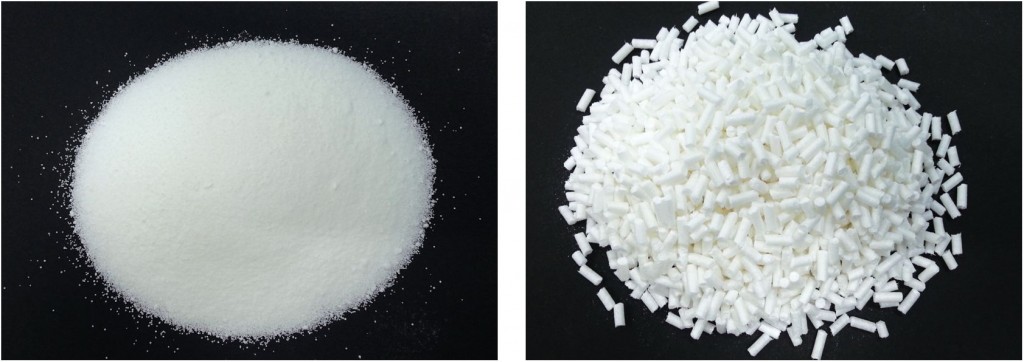
» Surface Active Agent (GMS, GLYCERINE MONOSTEARATE)
Anti-shrinkage agent to make light and resilient EPE foam
| Grade | Input quantity | Features |
|---|---|---|
| GMS98 (Powder) |
1~2% |
· The best surface active agent for EPE foam production · Specialized formula only for EPE foam extrusion · Antistatic characteristics · Less shrinkage in thickness, width and length of EPE foam after extrusion · Higher purity · Not crispy but softer foam to be acquired |
| GMS9850 (Pellet/Granule) Patent product |
1.6~1.8% |
· Lighter but softer, more resilient and stronger foam to be achieved · Input amount is constant and can be reduced in half · Foam surface is not oily because it disperses very well, penetrate into foam evenly without being left on the foam surface and do not make any mark so strong lamination with film/foil to be achieved. |
» Talc Master Batch
The best nucleating agent to guarantee fine cells of EPE foam
| Grade | Input quantity | Features |
|---|---|---|
| Talc M/B (Standard) |
1~1.2% | To make uniform, finer, and more consistent cell structure |
| TM-03 (Patent product) |
0.1~0.3% | TM-03 provides excellent resilience with much finer cells & numerous cells by its good dispersion rateProduction cost is saved a lot by very small dosing quantity. |
» Fire Retardant Master Batch (FR M/B)
-
· To make EPE foam perfect fire retardant
» Heat Resistant Master Batch (HR M/B)
-
· To stand high temperature upto 110’C
· The better heat-resisting property than XPE foam to be achieved
· Very resilient
· The better FR performance like rubber foam
» UV Protective Resin (UV M/B)
-
· To make foam strong against UV after application outside of building
Chemical Additives for Crosslinked PE(XPE/XLPE) Foam Production
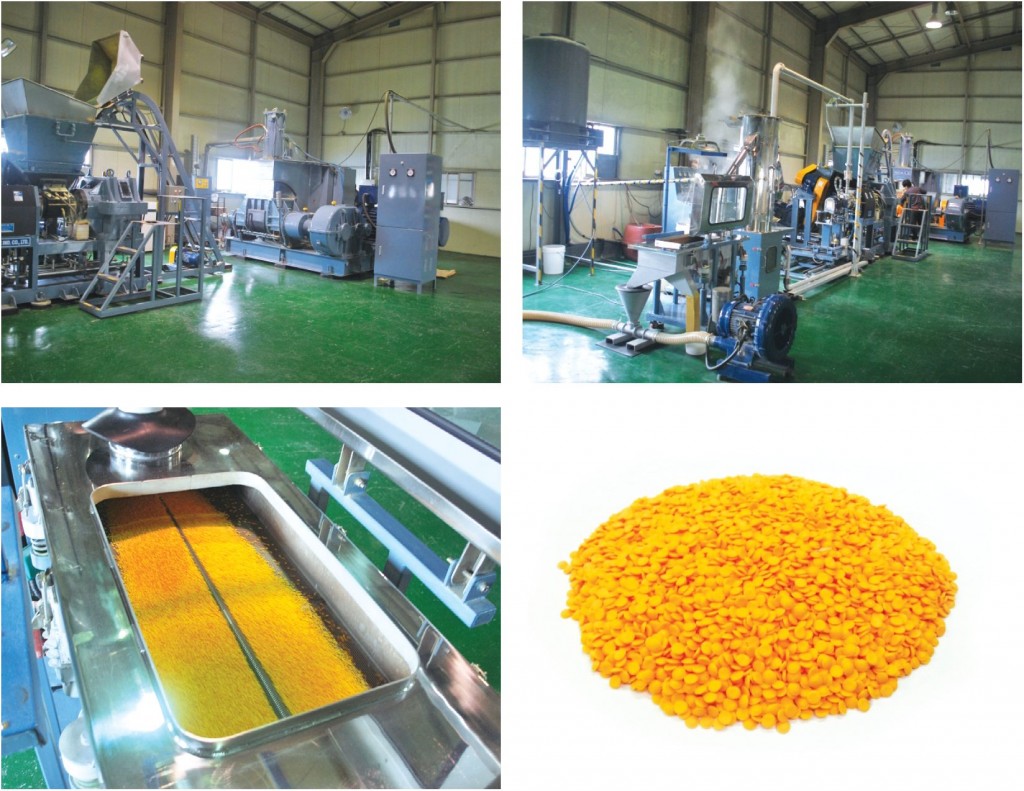
| Grade | Application | Advantages |
|---|---|---|
| PI-1001 | Our own development, Specialized for XPE foam production |
Uniform in low density and smooth foam surface by standing at high temperature, good heat resistance and wide range of adjusting temperature For thick foam up to 16mm |
| PI-1002 | Uniform fine cell foam in low density and smooth foam surface For thin foam up to 3~8mm | |
| PI-7000 | For rubber foam production | Temperature range is wide so you can easily play with its production condition |
» Blowing Agent(ADCA) Master Batch
-
· To guarantee good productivity with low yield less than 10%
» Blowing Agent Master Batch (VOC Free)
-
· VOC-free at 80℃ (Heat resistant at 110℃)
» Crosslinking Agent (DCP) Master Batch
-
· Excellent uniformity and dispersion
· Constant foam production without breakage during production
· Increased production speed by applying higher operating temperature
· Significant reduction in left/right deviation like side trimming
» Fire Retardant Master Batch
-
· To make XPE foam perfect fire retardant
» Fire Retardant Master Batch (Eco-Friendly)
-
· To make XPE foam perfect fire retardant free of decabrome and antimony
» Conductive Master Batch (ESD M/B)
-
· Available to produce ESD foam of 104-5
FAQ
1. What is the difference between GMS98 and GMS9850?
GMS98 is a powder-type additive that is dosed during the heating of raw materials through a GMS pump. Since it is injected in the middle of the extruder, marks or migration may occur on the foam surface, which can cause staining issues.
GMS9850, on the other hand, is a granule or pellet-type additive and is a patented product of Pacific Industry. It is designed to achieve shorter aging time and improved foam resilience. GMS9850 is pre-mixed with LDPE resin using a screw mixer and dispersed evenly, preventing any surface marks or migration. As a result, automotive parts remain free from GMS staining.
2. What is the difference and advantage between Talc M/B and TM-03?
The standard dosing quantity of Talc M/B is approximately 1.0–1.2%, whereas TM-03 requires only 0.1–0.3%.
TM-03 is a patented product that enables the production of foam with excellent resilience and much finer cell structure using a significantly smaller dosing quantity, resulting in higher efficiency and improved foam quality.
